Bubble Sort Java Code Example
Bubble Sort
In this tutorial, you will learn about the bubble sort algorithm and its implementation in Python, Java, C, and C++.
Bubble sort is a sorting algorithm that compares two adjacent elements and swaps them until they are not in the intended order.
Just like the movement of air bubbles in the water that rise up to the surface, each element of the array move to the end in each iteration. Therefore, it is called a bubble sort.
Working of Bubble Sort
Suppose we are trying to sort the elements in ascending order.
1. First Iteration (Compare and Swap)
- Starting from the first index, compare the first and the second elements.
- If the first element is greater than the second element, they are swapped.
- Now, compare the second and the third elements. Swap them if they are not in order.
- The above process goes on until the last element.
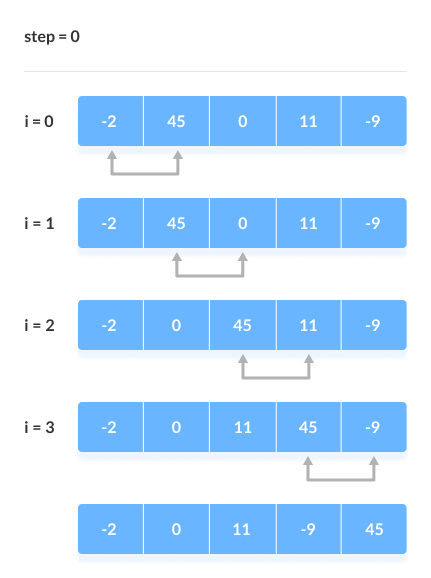
Compare the Adjacent Elements
2. Remaining Iteration
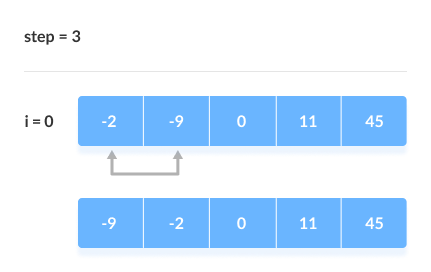
The same process goes on for the remaining iterations.
After each iteration, the largest element among the unsorted elements is placed at the end.
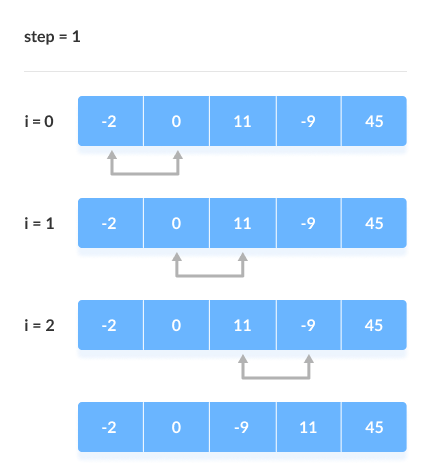
In each iteration, the comparison takes place up to the last unsorted element.
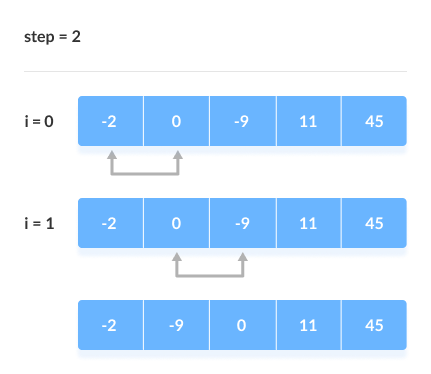
The array is sorted when all the unsorted elements are placed at their correct positions.
Bubble Sort Algorithm
bubbleSort(array) for i <- 1 to indexOfLastUnsortedElement-1 if leftElement > rightElement swap leftElement and rightElement end bubbleSort Bubble Sort Code in Python, Java and C/C++
# Bubble sort in Python def bubbleSort(array): # loop to access each array element for i in range(len(array)): # loop to compare array elements for j in range(0, len(array) - i - 1): # compare two adjacent elements # change > to < to sort in descending order if array[j] > array[j + 1]: # swapping elements if elements # are not in the intended order temp = array[j] array[j] = array[j+1] array[j+1] = temp data = [-2, 45, 0, 11, -9] bubbleSort(data) print('Sorted Array in Ascending Order:') print(data) // Bubble sort in Java import java.util.Arrays; class Main { // perform the bubble sort static void bubbleSort(int array[]) { int size = array.length; // loop to access each array element for (int i = 0; i < size - 1; i++) // loop to compare array elements for (int j = 0; j < size - i - 1; j++) // compare two adjacent elements // change > to < to sort in descending order if (array[j] > array[j + 1]) { // swapping occurs if elements // are not in the intended order int temp = array[j]; array[j] = array[j + 1]; array[j + 1] = temp; } } public static void main(String args[]) { int[] data = { -2, 45, 0, 11, -9 }; // call method using class name Main.bubbleSort(data); System.out.println("Sorted Array in Ascending Order:"); System.out.println(Arrays.toString(data)); } } // Bubble sort in C #include <stdio.h> // perform the bubble sort void bubbleSort(int array[], int size) { // loop to access each array element for (int step = 0; step < size - 1; ++step) { // loop to compare array elements for (int i = 0; i < size - step - 1; ++i) { // compare two adjacent elements // change > to < to sort in descending order if (array[i] > array[i + 1]) { // swapping occurs if elements // are not in the intended order int temp = array[i]; array[i] = array[i + 1]; array[i + 1] = temp; } } } } // print array void printArray(int array[], int size) { for (int i = 0; i < size; ++i) { printf("%d ", array[i]); } printf("\n"); } int main() { int data[] = {-2, 45, 0, 11, -9}; // find the array's length int size = sizeof(data) / sizeof(data[0]); bubbleSort(data, size); printf("Sorted Array in Ascending Order:\n"); printArray(data, size); } // Bubble sort in C++ #include <iostream> using namespace std; // perform bubble sort void bubbleSort(int array[], int size) { // loop to access each array element for (int step = 0; step < size; ++step) { // loop to compare array elements for (int i = 0; i < size - step; ++i) { // compare two adjacent elements // change > to < to sort in descending order if (array[i] > array[i + 1]) { // swapping elements if elements // are not in the intended order int temp = array[i]; array[i] = array[i + 1]; array[i + 1] = temp; } } } } // print array void printArray(int array[], int size) { for (int i = 0; i < size; ++i) { cout << " " << array[i]; } cout << "\n"; } int main() { int data[] = {-2, 45, 0, 11, -9}; // find array's length int size = sizeof(data) / sizeof(data[0]); bubbleSort(data, size); cout << "Sorted Array in Ascending Order:\n"; printArray(data, size); } Optimized Bubble Sort Algorithm
In the above algorithm, all the comparisons are made even if the array is already sorted.
This increases the execution time.
To solve this, we can introduce an extra variable swapped. The value of swapped is set true if there occurs swapping of elements. Otherwise, it is set false.
After an iteration, if there is no swapping, the value of swapped will be false. This means elements are already sorted and there is no need to perform further iterations.
This will reduce the execution time and helps to optimize the bubble sort.
Algorithm for optimized bubble sort is
bubbleSort(array) swapped <- false for i <- 1 to indexOfLastUnsortedElement-1 if leftElement > rightElement swap leftElement and rightElement swapped <- true end bubbleSort Optimized Bubble Sort in Python, Java, and C/C++
# Optimized Bubble sort in Python def bubbleSort(array): # loop through each element of array for i in range(len(array)): # keep track of swapping swapped = False # loop to compare array elements for j in range(0, len(array) - i - 1): # compare two adjacent elements # change > to < to sort in descending order if array[j] > array[j + 1]: # swapping occurs if elements # are not in the intended order temp = array[j] array[j] = array[j+1] array[j+1] = temp swapped = True # no swapping means the array is already sorted # so no need for further comparison if not swapped: break data = [-2, 45, 0, 11, -9] bubbleSort(data) print('Sorted Array in Ascending Order:') print(data) // Optimized Bubble sort in Java import java.util.Arrays; class Main { // perform the bubble sort static void bubbleSort(int array[]) { int size = array.length; // loop to access each array element for (int i = 0; i < (size-1); i++) { // check if swapping occurs boolean swapped = false; // loop to compare adjacent elements for (int j = 0; j < (size-i-1); j++) { // compare two array elements // change > to < to sort in descending order if (array[j] > array[j + 1]) { // swapping occurs if elements // are not in the intended order int temp = array[j]; array[j] = array[j + 1]; array[j + 1] = temp; swapped = true; } } // no swapping means the array is already sorted // so no need for further comparison if (!swapped) break; } } public static void main(String args[]) { int[] data = { -2, 45, 0, 11, -9 }; // call method using the class name Main.bubbleSort(data); System.out.println("Sorted Array in Ascending Order:"); System.out.println(Arrays.toString(data)); } } // Optimized Bubble sort in C #include // perform the bubble sort void bubbleSort(int array[], int size) { // loop to access each array element for (int step = 0; step < size - 1; ++step) { // check if swapping occurs int swapped = 0; // loop to compare array elements for (int i = 0; i < size - step - 1; ++i) { // compare two array elements // change > to < to sort in descending order if (array[i] > array[i + 1]) { // swapping occurs if elements // are not in the intended order int temp = array[i]; array[i] = array[i + 1]; array[i + 1] = temp; swapped = 1; } } // no swapping means the array is already sorted // so no need for further comparison if (swapped == 0) { break; } } } // print array void printArray(int array[], int size) { for (int i = 0; i < size; ++i) { printf("%d ", array[i]); } printf("\n"); } // main method int main() { int data[] = {-2, 45, 0, 11, -9}; // find the array's length int size = sizeof(data) / sizeof(data[0]); bubbleSort(data, size); printf("Sorted Array in Ascending Order:\n"); printArray(data, size); } // Optimized bubble sort in C++ #include using namespace std; // perform bubble sort void bubbleSort(int array[], int size) { // loop to access each array element for (int step = 0; step < (size-1); ++step) { // check if swapping occurs int swapped = 0; // loop to compare two elements for (int i = 0; i < (size-step-1); ++i) { // compare two array elements // change > to < to sort in descending order if (array[i] > array[i + 1]) { // swapping occurs if elements // are not in intended order int temp = array[i]; array[i] = array[i + 1]; array[i + 1] = temp; swapped = 1; } } // no swapping means the array is already sorted // so no need of further comparison if (swapped == 0) break; } } // print an array void printArray(int array[], int size) { for (int i = 0; i < size; ++i) { cout << " " << array[i]; } cout << "\n"; } int main() { int data[] = {-2, 45, 0, 11, -9}; // find the array's length int size = sizeof(data) / sizeof(data[0]); bubbleSort(data, size); cout << "Sorted Array in Ascending Order:\n"; printArray(data, size); } Bubble Sort Complexity
| Time Complexity | |
|---|---|
| Best | O(n) |
| Worst | O(n2) |
| Average | O(n2) |
| Space Complexity | O(1) |
| Stability | Yes |
Complexity in Detail
Bubble Sort compares the adjacent elements.
| Cycle | Number of Comparisons |
|---|---|
| 1st | (n-1) |
| 2nd | (n-2) |
| 3rd | (n-3) |
| ....... | ...... |
| last | 1 |
Hence, the number of comparisons is
(n-1) + (n-2) + (n-3) +.....+ 1 = n(n-1)/2 nearly equals to n2
Hence, Complexity: O(n2)
Also, if we observe the code, bubble sort requires two loops. Hence, the complexity is n*n = n2
1. Time Complexities
- Worst Case Complexity:
O(n2)
If we want to sort in ascending order and the array is in descending order then the worst case occurs. - Best Case Complexity:
O(n)
If the array is already sorted, then there is no need for sorting. - Average Case Complexity:
O(n2)
It occurs when the elements of the array are in jumbled order (neither ascending nor descending).
2. Space Complexity
- Space complexity is
O(1)because an extra variable is used for swapping. - In the optimized bubble sort algorithm, two extra variables are used. Hence, the space complexity will be
O(2).
Bubble Sort Applications
Bubble sort is used if
- complexity does not matter
- short and simple code is preferred
Similar Sorting Algorithms
- Quicksort
- Insertion Sort
- Merge Sort
- Selection Sort
Source: https://www.programiz.com/dsa/bubble-sort
0 Response to "Bubble Sort Java Code Example"
Post a Comment