How Do I Find an Honest Unbiased Review F Doctors in a Small Town?
The doc is in. To reach him, you lot must cantankerous the limestone-pillared entrance of his headquarters in Hoffman Estates and go past the chocolate-chocolate-brown paneled walls and soothing tiled lounge, down a labyrinth of hushful halls and empty conference rooms, to the door of a spacious corner role. Two soft knocks and a person instantly recognizable to almost any true laic in alternative medicine appears. The doctor is Joseph Mercola, the confront, the vocalization, the prime mover behind ane of the nation's most heavily trafficked—and controversial—natural health websites, Mercola.com.
He may not have the mainstream name recognition or rock-star appeal of, say, Mehmet Oz (though he has twice been a guest on The Dr. Oz Bear witness). But Mercola's influence is nonetheless considerable. Each calendar month, nearly two 1000000 people click to see the osteopathic md'due south latest musings on the wonders of dietary supplements and minerals ("The xiii Amazing Wellness Benefits of Himalayan Crystal Salt"), the marvels of culling therapies ("Learn How Homeopathy Cured a Boy of Autism"), and his take on medical research, from vaccines ("Your Flu Shot Contains a Unsafe Neurotoxin") to vitamin D ("The Silvery Bullet for Cancer?").
Visitors to his site are also treated to heavy doses of the contempt Mercola holds for most things traditional medicine and Big Pharma—the "medical-industrial complex," he calls it. Many followers are almost evangelical in their support of his bulletin. "If only the earth had more Dr. Mercolas!" wrote one in the comments section for "The Thugs of the Medical Globe," a Mercola.com article virtually drug companies. "You are a warrior sir, and your tireless, truthful, and fearless efforts to betrayal these criminals is much appreciated."
Not surprisingly, the medical establishment sees things differently. Some researchers and doctors say that Mercola steers patients away from proven treatments and peddles pseudoscientific misinformation on topics such as influenza shots and fluoridation. In their view, he is resurrecting quondam myths, such as the threat posed by mercury in dental fillings, and promoting new ones, such as the notion that microwave ovens emit harmful radiation. "The information he'due south putting out to the public is extremely misleading and potentially very unsafe," opines Dr. Stephen Barrett, who runs the medical watchdog site Quackwatch.org. "He exaggerates the risks and potential dangers of legitimate scientific discipline-based medical intendance, and he promotes a lot of unsubstantiated ideas and sells [sure] products with claims that are misleading."
Some of the articles on Mercola'south site, Barrett and others say, seem to exist as much about selling the wide array of products offered there—from Melatonin Slumber Support Spray ($21.94 for three 0.85-ounce bottles) to Organic Ocean Buckthorn Anti-Crumbling Serum ($22 for one ounce)—as about trying to inform. (Your tampon "may exist a ticking fourth dimension flop," he tells site visitors—only you tin buy his "worry-complimentary" organic cotton tampons for the discounted price of $7.99 for 16.) Steven Salzberg, a prominent biologist, professor, and researcher at the Johns Hopkins University Schoolhouse of Medicine, calls Mercola "the 21st-century equivalent of a snake-oil salesman."
Mercola says that his critics are incorrect on all counts. Far from dispensing dangerous misinformation or trading in conspiracy theories, as some allege, he is a champion of "taking accuse of our own health," the dr. insists—a truth teller alerting Americans to what he calls the abuses, hoaxes, and myths perpetrated by the multi-billion-dollar pharmaceutical and health insurance industries.
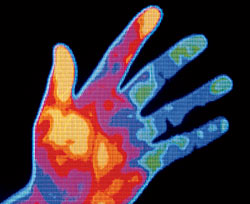
He's as well undaunted by his recurring run-ins with the Nutrient and Drug Assistants. Last March, the agency slapped the doctor with its third warning to stop making what information technology describes as unfounded claims. Specifically, the FDA demanded that Mercola cease touting a thermographic screening he offers—which uses a special camera to take digital images of skin temperatures—as a better and safer breast cancer diagnostic tool than mammograms. (As of presstime, Mercola's site had not removed the claims.) Mercola says that the FDA's statements are "without merit" and has had his lawyers ship a letter to the FDA telling information technology then. The FDA did not answer to repeated requests for comment.
Meanwhile, the Amend Business Bureau has tagged Mercola.com with an F rating, its lowest, due in office to client complaints that the company doesn't honor its 100 percent money-dorsum guarantee. That black mark isn't exactly the kind of thing that tends to boost revenues. Hoovers, a partition of Dun & Bradstreet, estimates that the privately held Mercola.com and Mercola LLC together brought in only under $7 million in 2010. (A Mercola spokesman didn't dispute that effigy.)
Simply those dollars don't reflect the extent of Mercola's influence. According to traffic-tracking firm Quantcast, Mercola.com draws about 1.9 million unique visitors per calendar month, each of whom returns an average of nearly x times a calendar month. That remarkable "stickiness" puts the site'southward full visits on a par with those to the National Institutes of Health's website. (Mercola claims his is "the world's No. 1 natural health website," citing figures from Alexa.com.) Mercola'due south 200,000-plus "likes" on Facebook are more than double the number for WebMD. And ii of his eight books—2003's The No-Grain Nutrition and 2006'due south The Keen Bird Flu Hoax—have landed on the New York Times bestseller listing.
Warrior or quack, straight shooter or charlatan, the question is the same: How has a site built on ideas so reverse to mainstream scientific discipline—then radical that fifty-fifty some staunch culling wellness advocates are uncomfortable with some of his positions—get then popular?
When I met Mercola in his suburban office one afternoon last fall, he was pleasant, articulate, enigmatic, and—understandably, perhaps—wary. Trim and athletic, with the salubrious vigor of a marathoner (which he was), the 57-year-onetime sported a crisp button-downward, pressed khakis, and the tan of someone who winters in the tropical climes of the well-to-exercise (which he does).
His golden hue is just i example of his rebellion against medical orthodoxy. Considering scientists have found excessive sunlight to be a likely carcinogen, dermatologists warn that there's no such affair every bit a salubrious tan. Mercola scoffs, arguing that sunlight is beneficial because exposure to it causes the body to create vitamin D. "I really never take vitamin D," he says. "I just get it from the sun."
He even advocates something considered outright heresy to virtually skin doctors: the use of tanning beds. Specifically, he recommends the Mercola Vitality Habitation Tanning Bed—on auction at his site for $2,997 ("Incredible Deal!"), costless shipping inside the continental United States for a express time, returns subject to customer-paid shipping plus a 15 percent restocking fee.
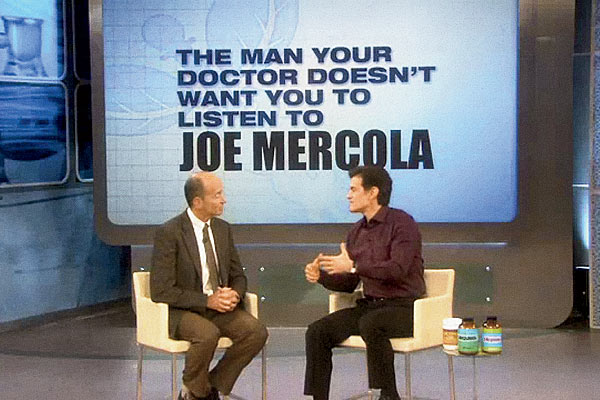
Mercola is well aware of his lightning-rod status. He really embraces it. He did not flinch, for example, when Oz introduced him on a 2011 Dr. Oz show equally "the most controversial guest I've always had . . . [a man who] is being called everything from game changer to innovator, controversial to quack." When I first asked about the mainstream critics who ridicule him, Mercola merely shook his caput, as if they weren't worth discussing.
In fact, he doesn't need to worry much about being controversial. Not when his in-your-face denunciation of the $2.6 trillion health care industry is resonating so well with an increasingly frustrated segment of the population. With wellness costs zooming and no convincing plan in place to curb them, "there is public dislike of Large Pharma and many managed care and wellness insurance companies," says Tom Smith, managing director of the National Opinion Inquiry Centre at the Academy of Chicago.
Mainstream doctors may find it well-nigh inconceivable that people could choose Mercola over accepted schools of thought. Only studies show a long erosion of public confidence in medicine, Smith says. Add in the poor economy of recent years and it'southward no surprise that people "are looking for treatment alternatives in full general and to Mercola in particular."
The numbers tell the story. Retail sales of vitamins accept soared from $2.4 billion in 2006 to $three.4 billion in 2011, co-ordinate to SymphonyIRI Grouping, a marketplace research firm in Chicago. Today nearly xl per centum of American adults seek some form of alternative health intendance, including reiki and ayurveda, the National Institutes of Health says. They are spending roughly $xxx billion a year out of pocket for visits to culling-care physicians and on related products. And the wellness care manufacture is taking heed: Some large health insurers at present cover sure treatments, such as acupuncture, that were once considered radical.
Mercola isn't your standard culling medicine guy, mind you. A spokesperson for the National Center for Complementary and Culling Medicine, a federal agency, declined to comment near Mercola specifically. But she provided position papers that contradict several of his views—for instance, on the authority of the FDA and on vaccination (more nearly that later).
Mercola'southward distrust-heavy spin seems to have hitting a particular nerve. "That's the fundamental sales hook," says Barrett. "That you can't trust the government, and considering I don't trust the government, you tin can trust me. And a lot of people don't trust the authorities for a lot of reasons."
Mercola didn't always stand on the fringes of health care. Early on, he eagerly embraced and so-called allopathic medicine—a term that originally referred to the practice of traditional health intendance merely has become a mocking putdown by certain alternative-medicine advocates.
Born and raised in Chicago, Mercola lacked professional function models at abode: His mother was a waitress and his father a deliveryman for Marshall Field's. But, he says, he was "always passionate about learning."
After graduating from Lane Tech College Prep High School and from the University of Illinois at Urbana-Champaign, where he majored in biology and chemistry, he got a job compounding prescriptions in the pharmacy of a medical center. Side by side came a degree from the Chicago College of Osteopathic Medicine, a small school in Downers Grove. (Dissimilar an MD, an osteopath, or Do, is trained to focus on prevention and holistic handling. DOs and MDs are considered equivalent past state licensing boards.)
In 1985, Mercola launched a small private practice out of an 800-foursquare-foot role in Schaumburg. At first, he was a traditional drug-prescribing doctor. He fifty-fifty worked equally a paid speaker for a drug company, promoting estrogen replacement therapy. "I idea drugs were the respond," he says with a shrug.
That inverse in the early 1990s, when conventional treatments failed to help a young patient with recalcitrant diarrhea. Flummoxed, Mercola establish a possible respond in a book called The Yeast Connexion. After he tried the all-natural protocol the volume recommended, he says, "the kid had a miraculous recovery."
Over the next several years, Mercola began networking with a number of similar-minded physicians "who were getting pretty good results with nontraditional therapies." He grew increasingly skeptical of traditional medicine and interested in treatments designed, he says, to "treat the whole person" rather than just symptoms. "I became very passionate about this new approach. I immersed myself in the science of diet and found peers who had amend results making patients truly responsible for the care of their bodies, teaching them how to do then without writing out a new drug prescription for each office visit."
In 1997, every bit a way to share what he had institute that would be "useful and helpful," he started Mercola.com. Information technology proved a striking. Only considering it didn't accuse for content or accept ads, it was besides a money drain. In the start 3 years, Mercola estimates that he spent half a one thousand thousand dollars on the site. To continue information technology afloat, he says, "I had three options: to become paid subscribers; to sell information, which I didn't desire to exercise; or to sell products, which is what I wound up doing. . . . The purpose for selling items is to have a revenue stream and then we can pay our staff to provide information to brainwash the public and make a difference and fund [our] initiatives."
The success of the site gave a pregnant boost to his practice, Mercola says: "I had people flying in from all over the earth. It always puzzled me: when people came in, I wouldn't tell them anything unlike than I had written on the site. They could accept just as easily looked it up for free. Only they had to hear it from me." (Mercola stopped practicing medicine vi years ago to focus on the website.)
His success likewise afforded some lifestyle perks. In 2006, for example, he bought a spacious $2 one thousand thousand waterfront home with a pool in tony S Barrington. But Mercola is not ane of those assuming-faced names who are regularly spotted rubbing elbows with the metropolis's society set. He has never married and has no children; he does have a girlfriend, he says, merely he declines to discuss her.
As he built his site, Mercola began filling it with articles he wrote, on subjects such equally his confidence that vitamin D "positively influences" conditions from centre disease to diabetes to cancer. (Some studies do advise that elevated levels of vitamin D may protect against certain cancers.) He shared his views about problems such as hospital-acquired infections and the overuse and improper use of antibiotics. He reiterated the importance of preventive care and said that spending more time with patients could assist them heal. And he recommended eating unprocessed foods and getting enough of practise. These are all stances that few mainstream doctors would fence with.
But he also took more than controversial positions. On pharmaceuticals, for example: "At that place are a few drugs—very, very few—that I would recommend." Amongst his reasons: Drugs treat symptoms rather than underlying causes, many are unproven, and they can crusade immense damage.
"You lot have more than than 100,000 people every year [in the United States] dying from taking legally prescribed drugs," Mercola says, citing a 1994 written report from the University of Toronto. "No people in a typical year are dying from vitamin supplements," he continues, his vox ascension. "And withal vitamins are vilified and drugs are identified as the hero. Information technology doesn't brand sense." (Information technology'southward not unknown for people to die from overusing supplements, which escape FDA review so long as they do not make health claims on the label.)
"Fraud. Kickbacks. Toll-setting, blackmail, and illegal sales activities," Mercola rants in a characteristically scathing web posting. "Add in all the doctored and back-dated documents, federal and civil lawsuits, and billions of dollars in government sanctions, fines, and penalties—non to mention the deaths—and you lot'd recollect it was the script for a thriller global action movie. Simply no, information technology's just Big Pharma at its deceitful best, dancing all the style to the bank while . . . endangering the lives of regular people similar you and me."
It's true, of form, that many prescription drugs accept been yanked from the market place over the years because of serious wellness risks and side effects. Consider Vioxx, which Mercola says he flagged as potentially dangerous years before Merck withdrew it in 2004 over reports that it raised the risks of center attack and stroke.
It'southward likewise true that not all drug companies have the cleanest reputations. Merely concluding Nov, British drug maker GlaxoSmithKline agreed to pay a tape $3 billion settlement to the U.Due south. government over allegations of improper sales and marketing practices involving numerous drugs, including the diabetes medication Avandia. Federal prosecutors also accused GlaxoSmithKline of paying doctors and manipulating enquiry to promote the drug, which has been linked to heart problems.
"In that location'south no dubiety that people dice afterwards taking conventional medicine," Salzberg says. "Those things happen and are bad and should exist corrected, absolutely. Just the solution is non to believe the claims of Dr. Mercola that because something is natural information technology'due south better. He's actually just changing the topic on you lot."
Joseph Ross, a cardiologist and an assistant professor of medicine at Yale University, agrees with Salzberg. "The issue is more complicated than Mercola is making it. Yes, in that location are bug with the [drug] industry, problems with the relationships between the industry and the profession, and problems with the medical literature due to industry distortions. Yet, many of the pharmaceuticals available to us today are both safe and constructive and are improving the lives of patients. I do not advocate throwing the baby out with the bath water."
But the stance that tends to drive Mercola's critics near crazy is his support of the antivaccination motion. A search of Mercola.com reveals dozens of articles and videos railing against nearly all vaccines, peculiarly mandatory ones for children. Amidst the titles: "Practise NOT Let Your Child Become Flu Vaccine—9 Reasons Why."
Mercola says he recently donated $1 million to several alternative medicine groups, including the National Vaccine Information Center, which describes itself every bit a "vaccine lookout canis familiaris." Part of the money, according to the group's website, was used to pay for an ad called "Vaccines: Know the Hazard," which was shown hourly on the CBS Jumbotron in Times Square for several weeks concluding jump.
Mercola says he is but trying to ask hard questions virtually the potential damage caused by inoculations and voice his opposition to regime-imposed mandates. "There are virtually no safety studies washed [on vaccines]," Mercola says. "We don't know what the effects of combining them are. Nosotros don't know what the long-term complications are." He says the government and media downplay very real risks and either underreport or ignore serious adverse reactions. Meanwhile, "we don't have the option to say no [to getting the shots]. It's merely insane what'south happening, and more and more vaccines [are coming] downwardly the line."
It'south one thing, Mercola'south critics say, to push unproven dietary supplements. It's another to advocate that parents shun something that has washed so much proficient. "When I was training l years ago, I saw kids who were deaf from measles, demented," Barrett says. "Vaccines salvage lives and they forestall disability."
More broadly, the CDC warns that a major drib in the number of children being vaccinated poses a threat to all Americans. That'due south because when a big enough portion of the population has immunity to a sure infectious disease, its spread becomes unlikely—and so-called herd amnesty. Failure to immunize kids, the CDC says, could issue in a return of diseases such every bit measles and polio that accept been all simply eradicated.
Mercola is nothing if not a gifted marketer. His site bristles with provocative headlines ("Do Drug Companies Secretly Favor a Earth Flu Pandemic?") and promises of astounding breakthroughs ("Zinc Can Cure Diarrhea"). And his enormous archive of blog posts and videos on wellness care topics from arthritis to shingles are all free—provided you share your email address. At the bottom of such articles are products from Mercola'southward own line that correspond to the topics he's just addressed. "He has applied the science of advice probably equally skillfully equally anyone who has e'er used the Internet," Mercola's principal critic, Barrett, acknowledges.
This skill is no accident. Around the time Mercola began to sell products on his site, he likewise began to report marketing. "I read a lot of books, took a lot of courses, and started understanding the process of how to communicate information finer."
Among the tricks he learned was how to grab readers' attention—the notion, for case, that "eighty percent of the effectiveness of an article is based on the headline." He also learned the ability of provocation. "I would find manufactures that supported ane position and [say] why I disagreed. I didn't concord back, and people seemed to like that. I didn't realize at the time that was a useful marketing principle."
If there were any doubt about the importance of marketing to the operation, it was dispelled when I was given a quick tour of Mercola's sprawling headquarters. The lobby of Dr. Mercola's Natural Health Middle looks similar the kind of well-appointed suburban part where you'd await vanity procedures such as face-lifts to be offered. As it turns out, simply one short hallway is dedicated to patient services. "Marketing and client service take upwardly near of the residual," a new-patient coordinator told me.
The medical pros on staff—a doc, a nutritionist, and 4 therapists—offer treatments such as the Emotional Freedom Technique (EFT), which Mercola describes as a "form of psychological acupressure, based on the aforementioned energy meridians used in traditional acupuncture." Another option: thermography, the screening method with advertizement claims that got Mercola into hot water with the FDA.
One fundamental element of Mercola's appeal—and the reason he is so confounding to some of his critics—is that plenty of the things he advocates are rooted in mutual sense and fifty-fifty proficient science. His site, for example, offers a thorough primer on proper mitt washing to avert spreading or catching the flu. Equally much every bit he pushes people to spend time in the lord's day, he also tells them to avert getting a sunburn and even to comprehend upwards in a way that allows plenty lord's day to become through while avoiding skin harm.
In the opinion of David Gorski, a dr. who runs a site like to Barrett'south (ScienceBasedMedicine.org), the trouble is that Mercola either vastly exaggerates preliminary enquiry or scarlet-picks studies that bolster his point of view. Gorski believes that Mercola likewise ignores data that evidence him wrong or pushes far across what is scientifically sound, using scare tactics to make his betoken. For case, his site includes an article by a California doc titled "HIV Does Not Cause AIDS." Mercola posted a comment at the end of the commodity: "Exposure to steroids and the chemicals in our environment, the drugs used to treat AIDS, stress, and poor nutrition are possibly the existent causes."
Gorski lists a litany of Mercola's behavior that he says fly in the face of good science. "It's all there," says Gorski. "He'south antivaccine. He has promoted [someone] who believes cancers are caused past fungus. He has promoted fear-mongering nearly shampoo. He digs up the hoary sometime myth that anti-perspirants containing aluminum cause breast cancer. But this month he is pushing this nonsense that somehow recombinant bovine growth gene in milk causes breast cancer, something for which there's no prove.
"Basically, if it's 'natural,' it's adept," Gorski says. "If it'southward pharmaceutical, it'due south evil. If anything boils his approach down to a short sound bite, that'south probably as shut equally I tin think of."
When I asked Mercola why the criticism against him past mainstream physicians is so harsh—and why the FDA has been on his case—he laughed. "It's a very elementary answer," he says. "There are enormous sums of money involved. There'southward this huge bunco betwixt government and industry. They leverage the federal regulatory agencies against united states to make us wait like we're breaking the police."
He pushes treatments and theories shunned by conventional medicine, he says, because "when you lot empathize the truth [you have a duty] to communicate that equally conspicuously and effectively as possible. I tin see things that are just obvious and clear to me. I don't need 30 more years of science to support it. Am I wrong sometimes? Sure. Anybody's wrong [sometimes]. . . . People call me a snake-oil salesman, of course. They're free to do that. I don't call back there's a justification for it."
As for his critics, Mercola views them as "pawns" of a arrangement in which medical journals have become an almighty arbiter of the scientific process. "It'due south how physicians and health care professionals validate their approach," he says. "Just use the journals. [That's fine] if you tin maintain objectivity and you don't corrupt it with conflict of interest. Unfortunately, that's non the case. These journals get corrupted. Then everyone downwardly the line steps in and says, 'Oh, the journals say it, the experts say information technology, and then who am I to say differently?' And they all autumn in step."
Salzberg strongly disagrees. "What people like Mercola sometimes ignore is that real medicines really work. They really piece of work because they undergo very strenuous testing. . . . Medical science is constantly critiquing itself. We're always skeptical about our ain results. The purveyors of supplements and 'alternative medicine,' including Mercola, are really not doing that at all."
In his coolly modern office—with its polished forest floors, caramel-colored leather furniture, and dramatic lighting—Mercola tells me he's not long for this world. That is, he won't be sticking around for the coming cold and sunless stretches of a Chicago winter. Every bit is the case every year at this time, he volition presently be off to more agreeable latitudes. "I typically go to warm climates such as S Florida, Mexico, Miami, the Caribbean," he explains. "My girlfriend has a home in Florida, so nosotros stay in that location sometimes." He notwithstanding works every mean solar day, he says. "I just work in shorts and T-shirts."
Of course, he besides enthusiastically chases rays. But without traditional sunscreens. Those are "loaded with toxic chemicals," states a posting on his website. Co-ordinate to researchers, the post continues, "nearly half of the 500 well-nigh pop sunscreen products may actually increase the speed at which malignant cells develop and spread skin cancer."
There is an alternative, a "major quantum in all natural sunscreen lotions," the site says: Dr. Mercola'due south Natural Sunscreen with Green Tea. Information technology's on sale for $15.97 for an 8-ounce canteen, just a mouse click away.
Source: https://www.chicagomag.com/Chicago-Magazine/February-2012/Dr-Joseph-Mercola-Visionary-or-Quack/
0 Response to "How Do I Find an Honest Unbiased Review F Doctors in a Small Town?"
Post a Comment